01
Alternative payment methods
Bank transfer, mobile money, wallets and local schemes, selected per corridor rather than bolted on as an afterthought.
- Per-corridor method sets
- Local currency presentment
- Method-level success monitoring
Taking a deposit is the easy half. Paying customers out reliably, across corridors where card rails barely function, is what separates a platform that grows from one that stalls at its first payout queue.
In most of the markets worth entering, the dominant payment method is not a card. A platform that only speaks card rails does not fail slowly — it fails at signup.
Bank transfer, mobile money, wallets and local schemes, selected per corridor rather than bolted on as an afterthought.
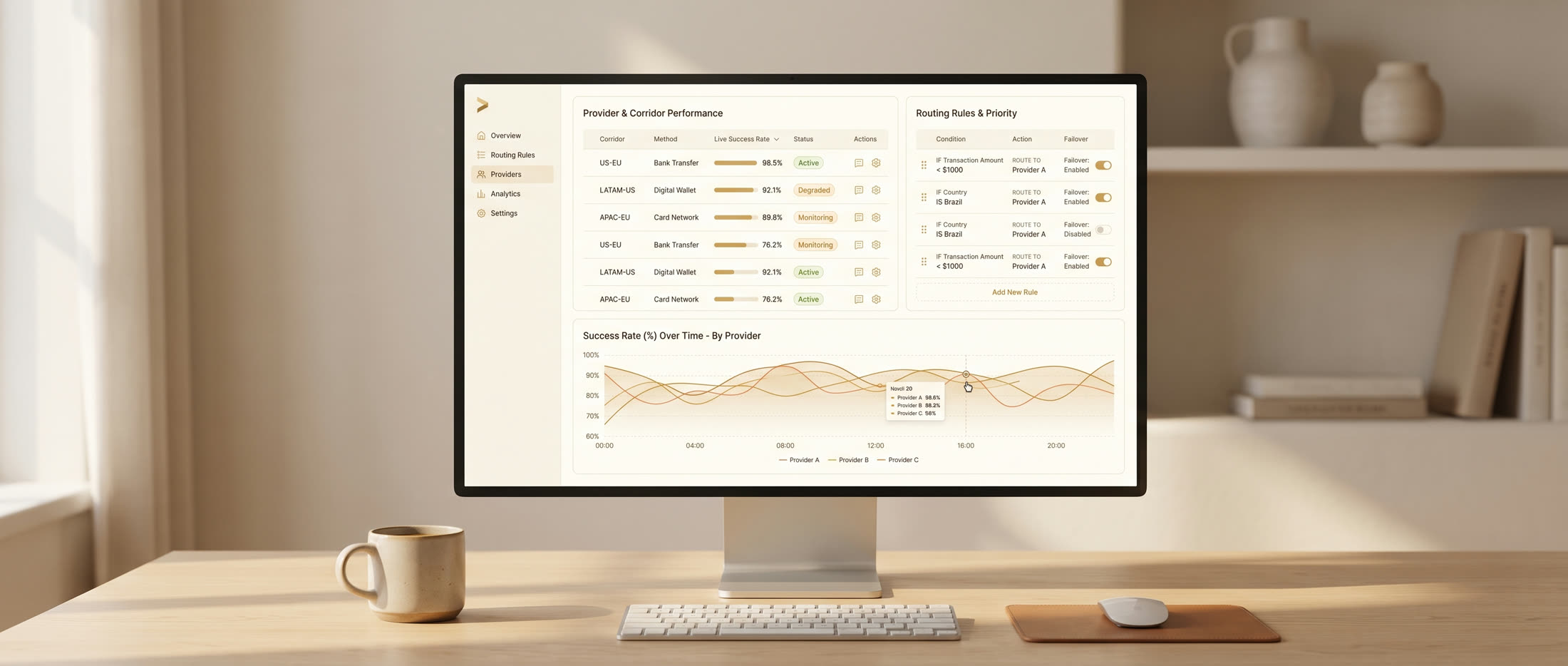
Traffic routed across providers by corridor, method and live success rate, with automatic failover when a provider degrades.
Automated withdrawal processing with approval thresholds, batching and full audit — the half of payments most vendors under-build.
Branded physical and virtual cards so balances get spent rather than withdrawn.
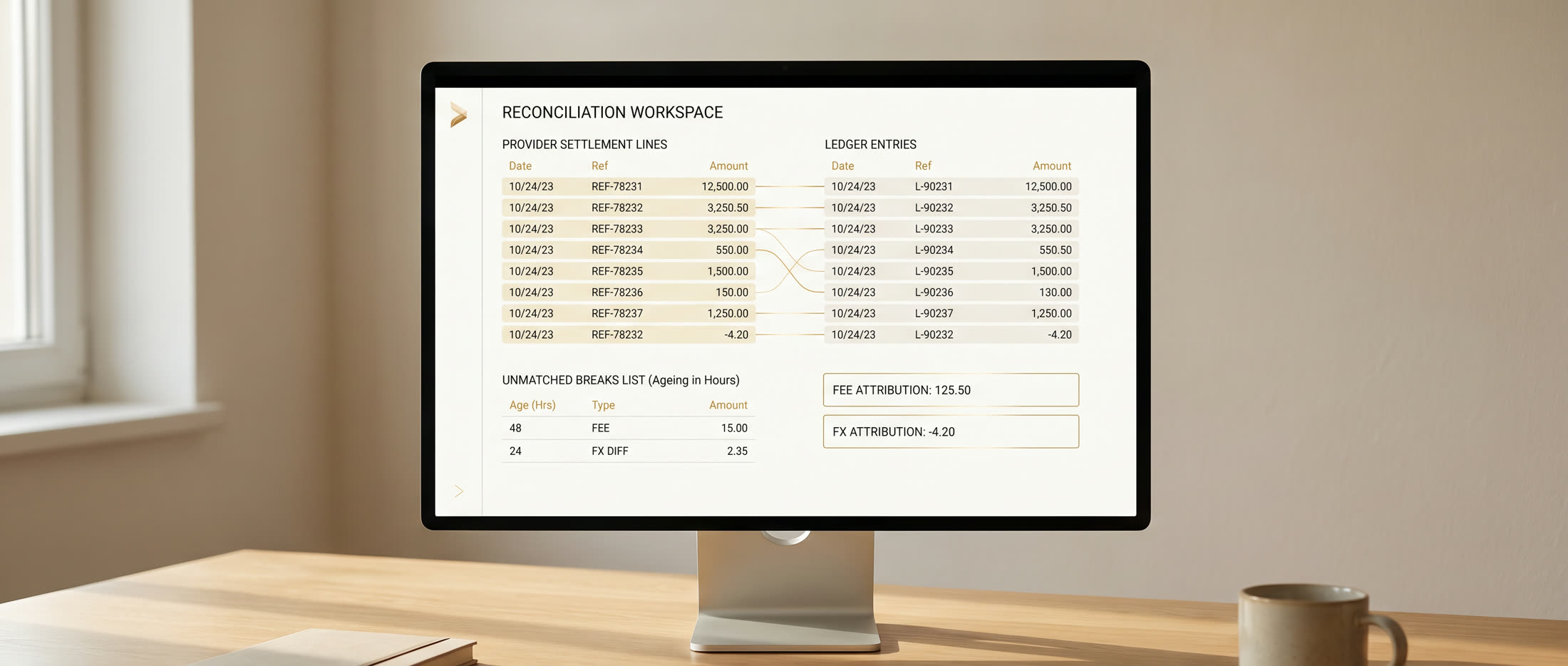
Provider settlement files matched against the ledger continuously, with breaks aged and surfaced rather than discovered at month end.
Africa, South and South-East Asia, the Gulf and Latin America. Markets where the incumbent processors settle slowly, freeze without warning, and price as though there were no alternative.
Corridor availability differs by method and by the licence you hold. We will tell you what works in your market before you sign, not after.
Corridor availability differs by method and by the licence you hold. Illustrative — we confirm what works in your market before you sign.
A virtual card exists the moment an account is approved — no plastic, no post, no waiting. Cardholders control it from the app you ship.
Move to tilt · click to turn over
Programme administration for the whole card estate: issue, freeze, replace and reconcile, with interchange economics visible rather than buried.
Move to tilt · click to turn over
In most markets worth entering, the dominant method is not a card. A platform that only speaks card rails fails at signup, not slowly.
Traffic routed by corridor, method and live success rate, with automatic failover when a provider degrades and a kill switch when it does not recover.
Settlement files matched against the ledger continuously, with breaks aged and attributed rather than found at month end.
Integration is the easy half. In most of these markets you cannot process at all without an authorisation or a sponsoring institution behind you — a path measured in months, with a capital requirement attached. Discovering that after signing costs a quarter. So here it is before.
Indicative market information for planning, gathered from public sources and subject to change. It is not legal or regulatory advice, and Krexum does not provide either. Confirm your position with counsel in each market — the authorisation you need depends on what you do, not only on where you do it.
Settlement timing is written into the agreement rather than left to a support article that can change. Where a corridor cannot support it, we say which one and why before you sign.
If compliance requires us to restrict an account, you get advance notice and a reason, except where the law forbids us to give it. Freezing a merchant without warning is the single most common complaint about gateways in these markets, and it is avoidable.
Adding a market is configuration on our side, not a second integration on yours. The API surface, webhook contract and reconciliation format do not change per corridor.
Per-corridor authorisation rates, provider mix and cost are reported to you, including when a provider is failing. A gateway that hides its decline reasons is hiding the reason to leave it.
Every movement produces a ledger entry, reconciled against the provider settlement file, with breaks surfaced in an exception queue rather than absorbed silently.
Card data is handled so that it does not land in your environment, which keeps your compliance burden proportionate to what you actually do.
Indicative for evaluation. The settlement timing, notice period and reporting that bind us are those written into your agreement.
These are the failures that decide whether a platform survives its first year in production. We list them because we have had to build for them.
Failures accumulate until someone notices the success-rate graph, usually after the support queue does.
Routing watches live success rate per corridor and method, fails over automatically, and holds the provider out until it recovers. The kill switch is also manual if you want it.